Best AI Planner Apps for 2026: Tools That Actually Help You Stay Organized
Published on May 6, 2026


Most scheduling apps still work the same way they did years ago.You manually create tasks. Rearrange calendar blocks. Rewrite priorities. Move unfinished tasks to tomorrow. Repeat.The problem is that organization itself becomes exhausting.AI planners are changing this by shifting from manual planning to adaptive assistance.Instead of forcing users to maintain complex productivity systems, AI planners can now:
- understand natural language
- organize tasks automatically
- prioritize workloads
- adapt schedules dynamically
- reduce planning friction
- protect focus time
The best AI planners in 2026 are becoming less like digital calendars and more like intelligent support systems for modern attention-heavy lifestyles.This is especially important for people struggling with ADHD, distraction overload, inconsistent routines, or burnout.Here are some of the most interesting AI planner tools redefining productivity in 2026.
How AI Planners Are Changing Productivity
Traditional planners are reactive.You tell the system what to do.AI planners are increasingly proactive.Modern systems can:
- reorganize your day automatically
- identify scheduling conflicts
- prioritize urgent work
- generate realistic schedules
- suggest focus sessions
- adapt when plans change
Many tools are also beginning to focus on cognitive sustainability rather than endless optimization.This shift toward adaptive productivity mirrors the broader evolution happening across AI scheduling and assistant platforms. (Lindy)
Elisi — A Simpler AI Planner for Focus and Mental Clarity
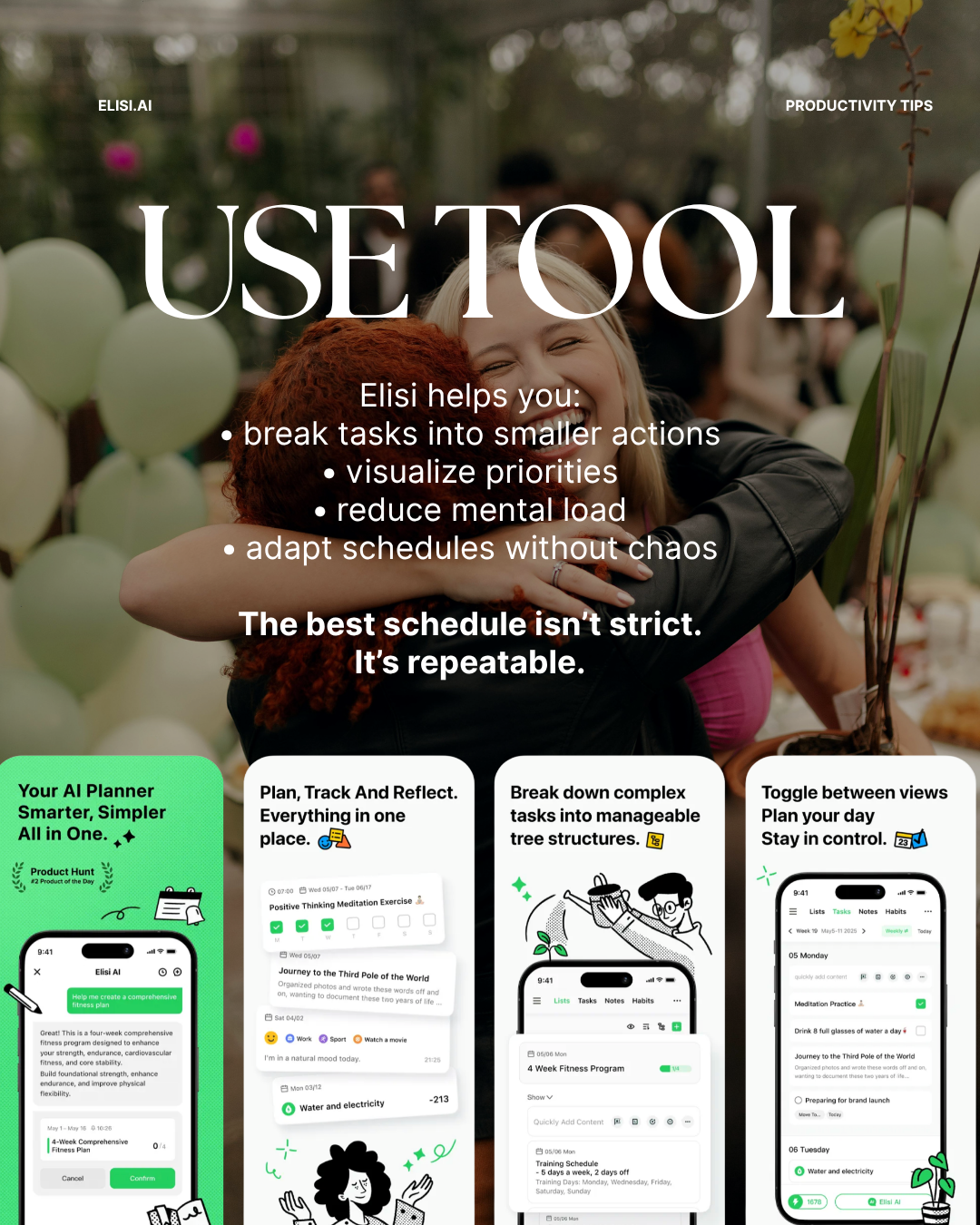
ElisiMany productivity apps become overwhelming very quickly.Too many dashboards.Too many folders.Too many systems to maintain.Elisi approaches planning differently.The platform focuses on reducing mental friction through a simplified interface and AI-assisted organization.
Planning Through Natural Language
One of Elisi’s core ideas is that planning should feel effortless.Instead of manually organizing tasks, users can simply type something like:
“Need to finish my portfolio, answer emails, study tonight, and clean the apartment.”
Elisi can automatically structure this into organized tasks and scheduling blocks.This lowers the activation energy required to start planning in the first place.Natural-language scheduling is becoming a major shift in modern AI planning systems because it removes unnecessary operational overhead from users. (Lindy)
A Clean UI Designed to Reduce Overwhelm
Many productivity tools unintentionally create visual stress.Elisi focuses heavily on interface simplicity.The design philosophy centers around:
- minimal visual clutter
- fast task capture
- clear prioritization
- lower cognitive overload
For users dealing with attention fragmentation or overstimulation, this becomes surprisingly important.
Tree-Style Task Organization
Large projects often feel overwhelming when everything appears in one endless task list.Elisi uses structured task hierarchies to help users break work into manageable layers.For example:
- Launch Campaign
- finalize visuals
- write landing page
- prepare content rollout
- schedule ads
This structure helps users visualize progress more clearly while reducing task paralysis.
Highlighting the 5 Most Important Tasks
One major problem with traditional productivity systems is overload.When users see dozens of tasks simultaneously, prioritization often collapses.Elisi surfaces the five most important priorities for the day to create clarity and reduce decision fatigue.Instead of constantly asking:
“What should I work on next?”
users can focus immediately on what matters most.
Built for ADHD and Attention Challenges
Many users struggle with productivity not because of laziness, but because of attention instability and executive dysfunction.Common problems include:
- difficulty starting tasks
- losing momentum after interruptions
- mental overload from large task lists
- constantly shifting attention
- anxiety around unfinished work
Elisi is designed around reducing these forms of friction.The platform emphasizes:
- easier task initiation
- simplified scheduling
- lower planning resistance
- adaptive organization
- sustainable productivity rhythms
Instead of assuming users function with perfect consistency every day, the system is designed around real-world attention patterns.
Motion — AI Scheduling for Highly Structured Workflows
MotionMotion focuses heavily on automated scheduling optimization.The system dynamically rebuilds schedules based on deadlines, workload priority, and calendar availability. (Lindy)
What It Handles Well
- automatic scheduling
- calendar restructuring
- deadline prioritization
- focus block creation
- meeting coordination
When plans change, Motion reorganizes schedules automatically.This can be especially useful for fast-moving work environments.
Reclaim AI — Intelligent Calendar Protection
Reclaim.aiReclaim AI focuses on balancing productivity with sustainable time management.Instead of simply filling calendars with tasks, it protects time for:
- habits
- breaks
- focus sessions
- recurring routines
The system automatically adapts around meetings and shifting workloads.This style of “calendar protection” is becoming increasingly popular in AI scheduling systems. (Lindy)
Sunsama — Planning With Less Pressure
SunsamaSunsama takes a calmer approach to productivity.Rather than maximizing output endlessly, the platform encourages realistic planning and intentional workloads.It is particularly popular among:
- freelancers
- creatives
- users prone to burnout
- people trying to avoid overcommitting themselves
Where AI Planning Is Heading Next
AI planners are evolving beyond basic scheduling tools.The strongest systems are increasingly focused on:
- reducing cognitive overload
- adapting dynamically to changing priorities
- understanding natural language
- protecting focus time
- supporting attention management
- minimizing decision fatigue
Instead of forcing users to behave like perfectly optimized machines, newer AI planners are beginning to adapt to how humans actually function:inconsistently, emotionally, dynamically, and under constant information overload.Among newer tools in this space, Elisi stands out for its combination of:
- minimalist UI
- one-sentence planning
- structured task organization
- intelligent prioritization
- ADHD-aware workflow design
For users overwhelmed by traditional productivity systems, this shift toward calmer and more adaptive planning tools may define the next generation of productivity software.